Learn More
Learn More with Us
Are you interested in learning more about Indigenous Knowledge and Culture? We have created this page to add resources we collect as a community. We have background resources for learning more about Indigenous Literature and resources for developing your library collection or classroom resources. We always encourage our community to purchase books from an Indigenous publisher or bookstore if possible. If you have any ideas for titles to explore, please send us your recommendations – for our seasonal meetings or for adult learning.
You can send an email to askwater@aqua.wisc.edu.
Background on Indigenous Children’s Books
To learn more about Indigenous children’s books, we recommend these resources:
-
American Indians in Children’s Literature (AICL)
-
A Broken Flute: The Native Experience in Books for Children
-
Earth Partnership: Indigenous Arts and Sciences Selected Bibliography for American Indian Studies
-
Exploring Indigenous Literature and Knowledge in Libraries
-
Native Ways of Knowing Book Club
-
Native Ways of Knowing Micro-Courses
For more information about Indigenous children’s books and many more, consult the Cooperative Children’s Book Center, an incredible resource from UW–Madison.
Buying Books
You can find the books we read, and many more, at your local library or at an independent bookstore near you. Please go first to an Indigenous-owned bookstore.
To order publications from the Great Lakes Indian Fish and Wildlife Commission, visit the GLIFWC store.
We are also excited to highlight Indigenous-owned publishing houses.
Please reach out to be included on our list!
Many of these in-person book stores have both brick-and-mortar and online storefronts, so even if you don’t live near one of these options, you can still order from them. Or check out the list of online bookstores.
In Person Bookstores (US & Canada)
- Birchbark Books (St. Paul, MN)
- Books and Burrow (Pittsburg, KS)
- Talking Leaves Indigenous Bookstore (Cherokee, NC)
- Black Walnut Books (Glen Falls, NY)
- Green Feather Book Company (Norman, OK)
- Red Salmon Arts Casa de Resistencia Books (Austin, TX)
- Quiet Quail Books (San Bernardino, CA)
- Nā Mea Hawaiʻi (Honolulu, HI)
- Native Books (Honolulu, HI)
- Iron Dog Books (Vancouver, British Columbia)
- Massy Books (Vancouver, British Columbia)
- Librairie Hannenorak (Wendake, Québec)
Online Bookstores (US & Canada)
Recommended Books for Adults
While we mostly read children’s books for Maadagindan, we have some recommendations for books written for adults.
The Murder of Joe White: Ojibwe Leadership and Colonialism in Wisconsin
Eric Redix. Michigan University Press, 2014.
An exploration of how the facets of American colonialism shaped the events that led to the death of Joe White and the struggle of the Ojibwe to resist removal to the reservation.
Purchase from Birchbark Books or read the dissertation that predates the book for free.
The Story of Act 31: How Native History Came to Wisconsin Classrooms
J.P. Leary. Wisconsin Historical Society Press, 2018.
“Since its passage in 1989, a state law known as Act 31 requires that all students in Wisconsin learn about the history, culture, and tribal sovereignty of Wisconsin’s Indian tribes. The Story of Act 31 examines how this law came to be, tracing its origins from a court decision in 1983 that affirmed Native hunting and fishing treaty rights in Wisconsin to the often-violent public outcry that following the court’s decision.”
Request from the Wisconsin Water Library or purchase from the Wisconsin Historical Society Press.
Community Reading
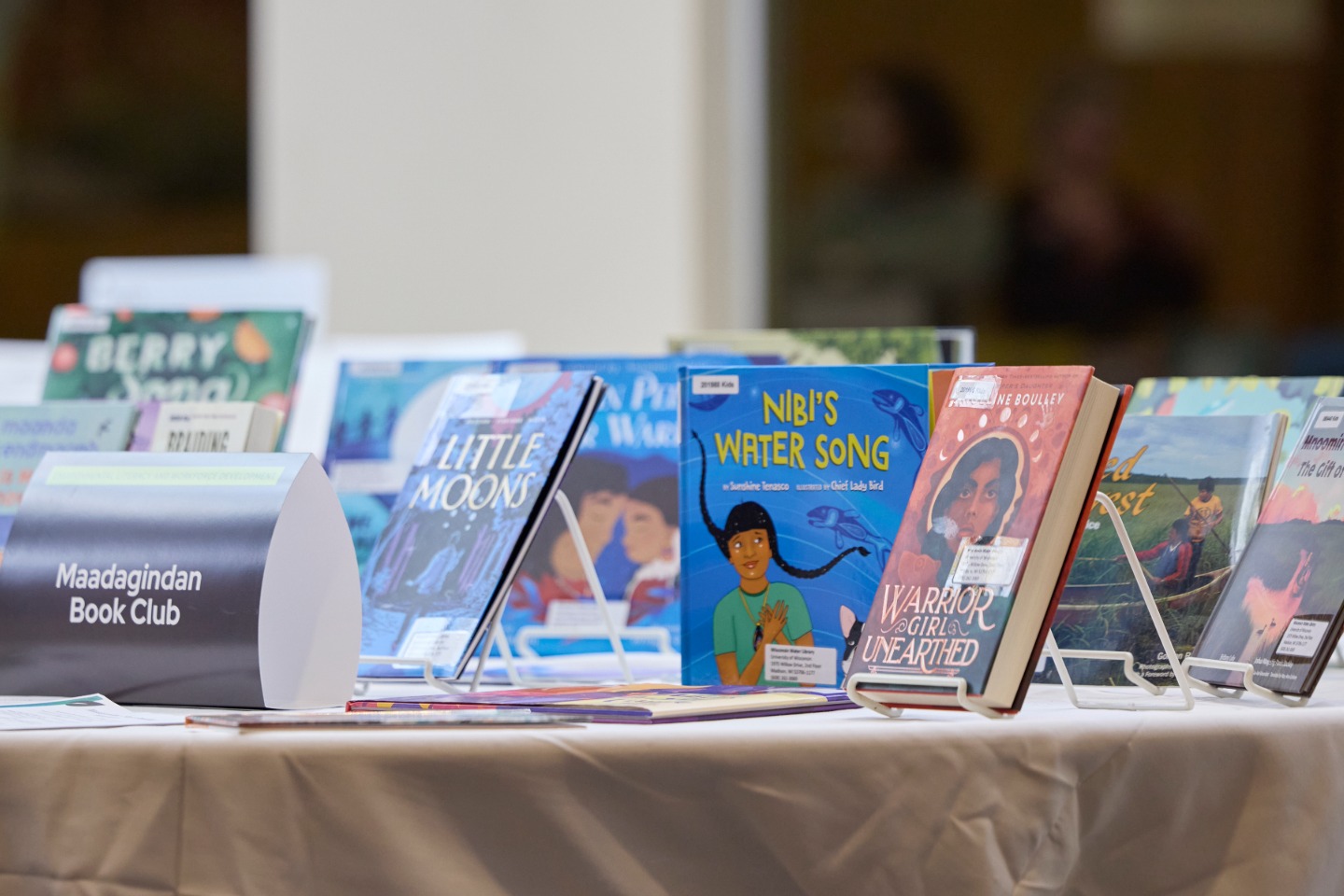
At every meeting, we share what we have been reading! Here are some of the books our Maadagindan community has been reading over the last few seasons.
- To Ride a Rising Storm by Moniquill Blackgoose
- Sisters in the Wind by Angeline Boulley
- The Correspondent by Virginia Evans
- The Girl Who Loved Wild Horses by Paul Goble
- Everything Is Tuberculosis by John Greene
- Medicine Wheel for the Planet: A Journey Toward Personal and Ecological Healing by Jennifer Grenz
- The Midnight Library by Matt Haig
- Night Magic by Leigh Ann Henion
- Bad Indians Book Club: Reading at the Edge of a Thousand Worlds by Patty Krawec
- The Country of the Blind: A Memoir at the End of Sight by Andrew Leland
- Shemay: The Bird in the Sugarbush by Minnesota Council on Quality Education (Primary Contributor)
- Notes from a Young Black Chef by Kwame Onwuachix
- There There by Tommy Orange
- The Art of Gathering by Priya Parker
- The True Meaning of Smekday by Adam Rex
- Legendary Frybread Drive-In: Intertribal Stories edited by Cynthia Leitich Smith
- The Hidden Life of Trees: A Graphic Adaptation by Peter Wohlleben, adapted by Fred Bernard and illustrated by Benjamin Flao
Register for Upcoming Meetings
Or check out our list of past seasons and the books we’ve read.